Top 12 K-Pop Idols: Can You Match Their Net Worth in a Lifetime? 2026 rankings, income sources, and the salary math you need to see.
The Number That Will Ruin Your Morning Commute
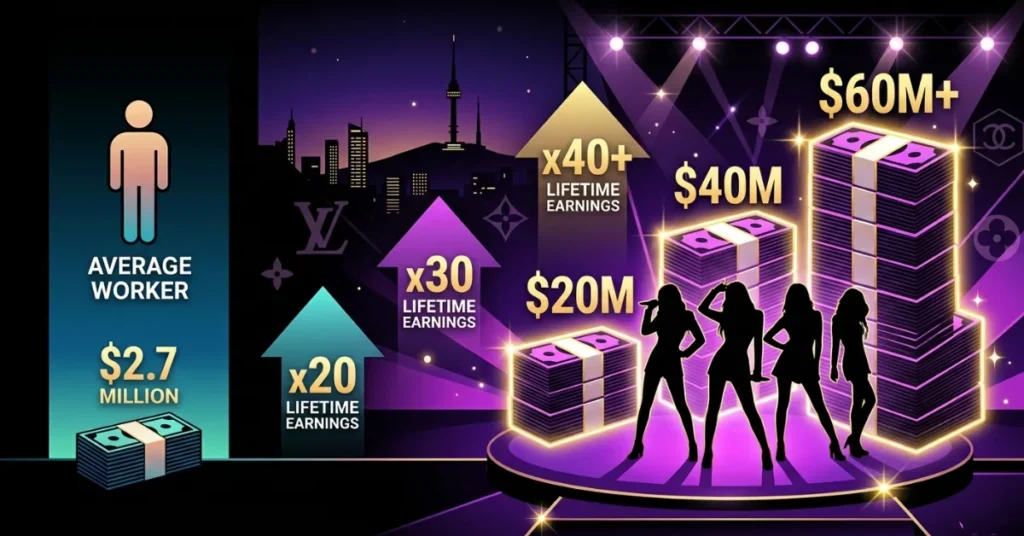
Here’s a thought experiment. You earn the U.S. median salary around $62,000 a year. You work every single year from 22 to 65, never miss a paycheck, and spend nothing. You’d retire with about $2.7 million. BTS’s V made more than that from brand deals alone in a single year. So did several other K-pop idols you’re about to meet.
That’s the real question behind “Top 12 K-Pop Idols: Can You Match Their Net Worth in a Lifetime?” and the answer, once you see the actual math, is both more illuminating and more humbling than you’d expect.
K-pop isn’t just a music genre anymore. It’s a wealth-generation machine and in 2026, with all seven BTS members freshly returned from mandatory military service and the industry riding a post-hiatus comeback wave, the money figures are more eye-watering than ever. BTS’s economic contribution is estimated at $4.6 billion+ annually to South Korea’s GDP (Source: Hyundai Research Institute).
This isn’t a simple ranked list. We’re going to break down how each idol built their fortune, identify the income streams that actually drive their wealth, and do the uncomfortable math on how many working lifetimes it would take the average person to get there. We’ll cover: the top 12 richest K-pop idols by 2026 net worth, their primary income engines, a myth-busting section, and a full comparison table with a “lifetimes to match” column.
The “Lifetime Math” Baseline: How We’re Measuring This
Before we rank anyone, let’s establish a real-world benchmark because without it, numbers like “$50 million” are just abstractions.
| U.S. Median Full-Time Salary (2026) | ~$62,000/year (Source: U.S. Bureau of Labor Statistics, Q4 2025) |
| Working Years (Age 22–65) | 43 years |
| Total Lifetime Earnings (Gross) | ~$2.67 million before taxes |
| After-Tax Lifetime Earnings | ~$2.08 million (est. 22% effective rate) |
So when you see a net worth of $50 million below, that idol has accumulated the equivalent of roughly 24 average American working lifetimes or closer to 30 lifetimes on an after-tax basis.
Top 12 K-Pop Idols: Can You Match Their Net Worth in a Lifetime? Here’s the Full Ranking
#1. PSY
Estimated Net Worth: $60–75 Million Lifetimes to Match: ~23–28 lifetimes
Park Jae-sang stage name PSY is the unlikely godfather of K-pop’s global financial moment. Before BTS conquered the world, PSY cracked it open. “Gangnam Style” wasn’t just a song; it was a seismic cultural event that broke YouTube’s view counter and put Korean entertainment on the financial map. But PSY’s wealth isn’t just a one-hit-wonder payoff. He is the founder and CEO of P NATION, a Seoul-based entertainment label, giving him an executive income stream and equity stake. He commands premium global performance fees and earns ongoing royalties from a catalog that still racks up billions of streams. The key distinction: PSY has executive money, not just artist money. “Gangnam Style” is the foundation; P NATION is the building.
How they built it:
- Touring fees (reportedly $300,000 per single concert appearance at peak)
- Streaming and music royalties from catalog
- P NATION label equity and management fees
- Television, film, and endorsement income
#2. V (Kim Taehyung) – BTS
Estimated Net Worth: $35–50 Million Lifetimes to Match: ~13–19 lifetimes
Within BTS, V consistently tops individual net worth estimates. He holds major brand ambassadorships with Celine and Cartier two of the most prestigious luxury houses in the world with multi-year deals that pay in the eight-figure range. His 2023 solo album Layover was a commercial and critical success, adding significant royalty income. Late 2025 brought new commercial partnerships, including a Compose Coffee deal in South Korea. The HYBE stock equity piece is something most casual fans miss: when Big Hit Entertainment went public in 2020, BTS members received shares that made several of them quietly wealthy in ways that don’t show up in streaming numbers.
How they built it:
- HYBE stock equity (distributed as part of the Big Hit/HYBE IPO structure)
- Celine and Cartier luxury ambassadorships
- Solo music royalties (Layover)
- Seoul real estate investments
- Touring dividends from BTS group income
#3. Jungkook (Jeon Jung-kook) – BTS
Estimated Net Worth: $30–50 Million Lifetimes to Match: ~11–19 lifetimes
Jungkook is the youngest BTS member and one of its biggest individual earners. “Seven” became one of the fastest songs in history to reach 100 million Spotify streams, and his debut album Golden was a global commercial event. His Louis Vuitton ambassadorship is one of the most prominent luxury brand deals in K-pop. Between 2019 and 2020 alone, his share of BTS touring revenue was reported at approximately $7 million, with a further $7.9 million from Big Hit Entertainment shares. That was five years ago.
How they built it:
- Louis Vuitton global brand ambassador (estimated deal value: $10M+)
- Solo career: Golden album royalties and “Seven” streaming income
- BTS HYBE stock equity
- Group touring revenue share
- Multiple domestic Korean brand endorsements
#4. Jin (Kim Seok-jin) – BTS
Estimated Net Worth: $45–50 Million Lifetimes to Match: ~17–19 lifetimes
Jin’s net worth often surprises people who expected military service (completed mid-2025) to stall his trajectory. It didn’t. He maintained brand deals throughout his service and returned to an industry hungry for BTS content. Post-military, his market value has arguably increased the cultural narrative of a global superstar who chose to honor his service obligation adds brand cachet that no PR campaign could manufacture.
How they built it:
- BTS group revenue share and HYBE equity
- Seoul real estate portfolio
- Post-military solo music pipeline
- Brand endorsements maintained through service period
#5. IU (Lee Ji-eun)
Estimated Net Worth: $40–50 Million Lifetimes to Match: ~15–19 lifetimes
IU is the wealthiest solo idol every dollar built independently, without the collective power of a BTS-scale group. She is simultaneously a chart-dominating singer-songwriter, a celebrated actress whose dramas regularly top Korean viewership charts, and one of the most sought-after brand endorsers in the country. She writes and produces much of her own music, capturing publishing royalties in addition to performance royalties a distinction that dramatically increases long-term income. No single income stream makes up more than 30% of her total wealth.
How they built it:
- Solo music royalties including publishing (KOMCA-registered songwriter)
- K-drama acting fees lead roles in major productions
- Luxury and domestic brand endorsements
- Real estate investments
- Long-term Kakao Entertainment management relationship
#6. G-Dragon (Kwon Ji-yong)
Estimated Net Worth: $45–55 Million Lifetimes to Match: ~17–21 lifetimes
G-Dragon is widely credited as one of the architects of modern K-pop’s global aesthetic. His influence on fashion, music production, and the genre’s visual identity is structural, not just stylistic. As a songwriter, he generates substantial annual royalties reportedly up to $700,000/year from music copyright alone. His endorsement history spans Chanel, Nike, and his own label Peaceminusone, operating at the intersection of high fashion and street culture in a way no Korean artist had before him.
How they built it:
- Prolific songwriter and producer royalties (~$700K/year in music copyright income)
- Peaceminusone fashion brand (self-owned equity)
- Luxury real estate including a reported ₩9 billion penthouse in Hannam, Seoul
- Endorsements: Chanel, Nike, Shinsegae, and international luxury brands
- Big Bang group income and post-service solo activity
#7. Lisa (Lalisa Manobal) – BLACKPINK
Estimated Net Worth: $35–40 Million Lifetimes to Match: ~13–15 lifetimes
Lisa is the most globally followed K-pop idol on social media and the first K-pop solo artist to reach one billion streams on Spotify. Being Thai opened markets across Southeast Asia that other BLACKPINK members couldn’t access as organically, amplifying her brand deal value significantly. She founded her own agency, LLOUD, in 2024, transitioning from talent to executive a critical wealth-acceleration move that places her in the same structural tier as PSY.
How they built it:
- Solo music: Lalisa, Money, and associated streaming income
- LLOUD independent label equity
- Celebrity brand partnerships across Southeast Asian markets
- International touring and performance fees
#8. Jennie (Jennie Kim) – BLACKPINK
Estimated Net Worth: $30–35 Million Lifetimes to Match: ~11–13 lifetimes
Jennie’s brand architecture is arguably the most sophisticated of any K-pop idol. A multi-year Chanel ambassadorship places her alongside Lily-Rose Depp and other global Chanel faces. Her 2024 collaboration with Dua Lipa, “Handlebars,” broke into the Billboard Hot 100. She founded ODD ATELIER, expanding her revenue base decisively beyond performance income.
How they built it:
- Chanel global ambassador (one of K-pop’s highest-value single brand deals)
- Solo music releases and international collaboration royalties
- ODD ATELIER agency equity
- BLACKPINK group touring and merchandise income
#9. J-Hope (Jung Ho-seok) – BTS
Estimated Net Worth: $25–35 Million Lifetimes to Match: ~9–13 lifetimes
J-Hope’s solo world tour for D-DAY demonstrated that BTS members can carry stadium-level tours independently. His Valentino ambassadorship and NBA global partnership are both high-profile, high-value deals. His documentary j-hope IN THE BOX opened an additional revenue and brand equity dimension, and he holds multiple confirmed Seoul real estate properties.
How they built it:
- Valentino luxury ambassadorship
- NBA global partnership
- D-DAY world tour revenue
- Solo music royalties and documentary income
- Seoul real estate portfolio and HYBE equity
#10. Suga (Min Yoon-gi / AGUST D) – BTS
Estimated Net Worth: $25–30 Million Lifetimes to Match: ~9–11 lifetimes
Suga’s wealth is heavily producer-driven. As a songwriter and producer for BTS and external artists his producing credit on PSY’s “That That” reached global audiences he accumulates royalties that compound in ways pure performers cannot replicate. His D-DAY world tour was a significant standalone financial milestone, and his Valentino partnership was one of the most unexpected high-fashion moves of 2023.
How they built it:
- Songwriting and production royalties (BTS catalog + external credits)
- AGUST D solo career and world tour
- Valentino brand partnership
- HYBE equity stake
#11. Rosé (Roseanne Park) – BLACKPINK
Estimated Net Worth: $20–25 Million Lifetimes to Match: ~7–9 lifetimes
Rosé’s “APT.” collaboration with Bruno Mars was one of the most-streamed cross-genre tracks globally in late 2024, delivering a meaningful new royalty stream. Her Saint Laurent ambassadorship is one of the cleanest brand-idol alignments in the industry. Her debut solo album rosie (2024) significantly expanded her standalone commercial profile.
How they built it:
- “APT.” collaboration royalties (Bruno Mars)
- rosie solo album music income
- Saint Laurent luxury ambassadorship
- BLACKPINK group touring and merchandise income
#12. Jisoo (Kim Ji-soo) – BLACKPINK
Estimated Net Worth: $18–22 Million Lifetimes to Match: ~7–8 lifetimes
Jisoo rounds out this list having built a portfolio that extends meaningfully beyond music. Her acting career (Snowdrop) and the 2024 founding of Blissoo mark her transition from group member to independent business operator. Her Dior and Cartier ambassadorships remain active, and her dedicated fanbase drives consistent merchandise and streaming revenue independent of BLACKPINK group activity.
How they built it:
- Dior and Cartier luxury ambassadorships
- Blissoo agency equity
- Snowdrop acting income and subsequent K-drama roles
- Solo music releases
- BLACKPINK group activity revenue
Also read about: Best 9 Taylor Swift Eras: Years to Match Her 2026 Net Worth
Net Worth vs. a Lifetime of Work: Full Comparison Table
| Rank | Artist | Est. Net Worth (2026) | Primary Wealth Driver | Lifetimes to Match* |
| 1 | PSY | $60–75M | Label equity + catalog royalties | 23–28 |
| 2 | V (BTS) | $35–50M | Luxury ambassadorships + HYBE equity | 13–19 |
| 3 | Jungkook (BTS) | $30–50M | Solo career + LV deal + HYBE equity | 11–19 |
| 4 | Jin (BTS) | $45–50M | HYBE equity + real estate | 17–19 |
| 5 | IU | $40–50M | Songwriting royalties + acting + endorsements | 15–19 |
| 6 | G-Dragon | $45–55M | Fashion brand + royalties + real estate | 17–21 |
| 7 | Lisa (BLACKPINK) | $35–40M | LLOUD equity + streaming + global deals | 13–15 |
| 8 | Jennie (BLACKPINK) | $30–35M | Chanel deal + OA equity + solo music | 11–13 |
| 9 | J-Hope (BTS) | $25–35M | Valentino deal + touring + real estate | 9–13 |
| 10 | Suga (BTS) | $25–30M | Production royalties + HYBE equity + touring | 9–11 |
| 11 | Rosé (BLACKPINK) | $20–25M | Saint Laurent deal + APT. royalties | 7–9 |
| 12 | Jisoo (BLACKPINK) | $18–22M | Dior/Cartier deals + Blissoo + acting | 7–8 |
Based on U.S. median gross lifetime earnings of ~$2.67M (working age 22–65 at ~$62K/year, BLS Q4 2025). Net worth figures are estimates from Celebrity Net Worth, Kpopbeen, and industry analysts. Exact figures are not publicly disclosed.
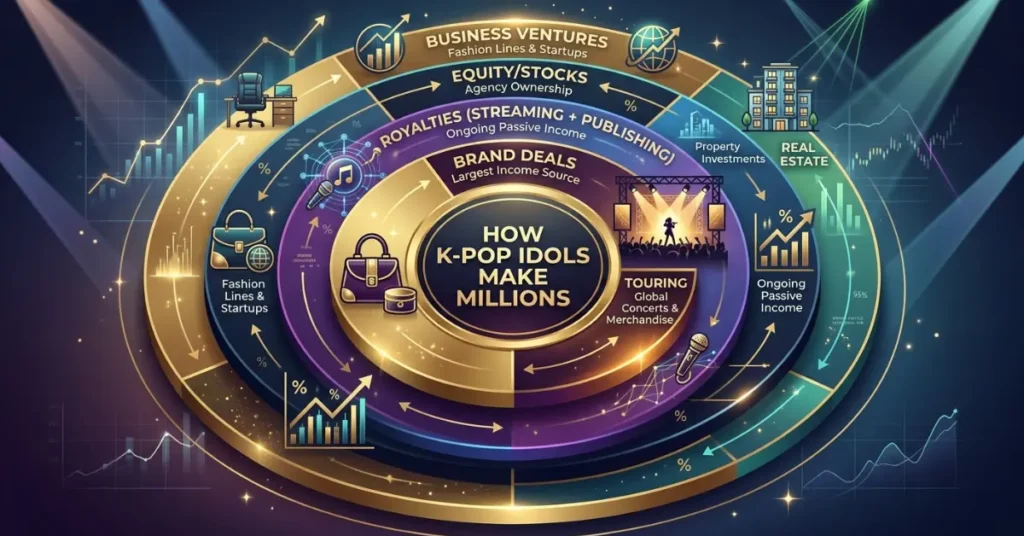
How K-Pop Idols Actually Make Money: The Income Stack
Most people think a K-pop star’s money comes from album sales and concert tickets. That’s maybe 20–30% of the picture for the top tier. The real income stack is far more layered.
1. Music Royalties (Performance + Publishing) Performance royalties come when a song is streamed or played. Publishing royalties come when an artist wrote the song. Idols who write IU, G-Dragon, Suga, RM capture both. That’s why songwriters accumulate lasting wealth long after a song’s moment in the charts has faded.
2. Brand Ambassadorships This is where the real money lives. A global luxury brand deal (Louis Vuitton, Chanel, Celine, Dior, Cartier) can be worth $5–15 million over a multi-year contract. Top K-pop idols often hold 3–5 simultaneous deals.
3. Equity Stakes (Label/Company Shares) When Big Hit Entertainment went public in 2020 as HYBE, BTS members held shares. HYBE’s market cap has fluctuated between $4–10 billion. Even a fraction of 1% equity is worth millions the wealth multiplier that separates BTS from nearly every other K-pop act.
4. Real Estate Seoul’s Gangnam and Hannam districts have seen real estate appreciation of 40%+ over the last decade. Several idols on this list own multiple properties. G-Dragon’s penthouse purchase alone has likely appreciated by hundreds of millions of Korean Won since 2020.
5. Independent Labels and Business Ventures Lisa (LLOUD), Jennie (ODD ATELIER), Jisoo (Blissoo), and PSY (P NATION) all earn executive income recurring, scalable, and not dependent on touring.
6. Acting and Media IU leads here, but Jisoo and others use acting as both a personal revenue stream and brand value amplifier. A well-received K-drama performance can increase an idol’s endorsement rate by 20–40%.
The Trainee Debt Story: From Zero to $50 Million
Here’s what makes these fortunes even more remarkable. Most K-pop idols began their careers in debt.
The K-pop trainee system requires aspiring idols to train for 3–7 years before debut, with all costs vocal training, dance lessons, language classes, housing charged against their future earnings. A trainee who debuts after five years can enter their career already owing their label hundreds of thousands of dollars.
This debt is repaid from group earnings before individual income flows. For acts that never broke through, that debt is never recovered. For the 12 people on this list, it was erased within years sometimes months of a successful debut.
The arc from trainee debt to the wealth figures above is the defining financial story of the K-pop era. When people ask whether you can match these top 12 K-pop idols’ net worth in a lifetime, the honest answer starts here with the understanding that these idols didn’t just earn more than most people. They started from further behind.
Myth vs. Fact: What People Get Wrong About K-Pop Money
Myth: K-pop idols are paid like employees with salaries.
Fact: Top-tier idols are not salaried. They earn royalty shares, touring revenue splits, and in the case of BTS, company equity. It’s a complex revenue-share structure that varies by label and contract generation.
Myth: Streaming is the main income source.
Fact: For most artists, streaming pays fractions of a cent per play. Even a billion Spotify streams generates roughly $3–5 million before splits. For top K-pop idols, brand deals and touring generate far more. Streaming is an audience-building tool that enables the deals that actually pay.
Myth: BLACKPINK members are equally wealthy.
Fact: Lisa and Jennie have significantly higher net worths than Rosé and Jisoo, primarily due to earlier and larger solo brand partnerships and independent label formations. Group activities generate roughly equal income, but solo ventures have created a measurable wealth gap.
Myth: PSY’s money came entirely from “Gangnam Style.”
Fact: “Gangnam Style” launched his global profile, but his sustained wealth comes from P NATION’s label operations, ongoing royalty income, and executive activity. The song opened the door; the business walked through it.
Myth: Military service permanently derails financial growth.
Fact: For BTS members, military service ran 2023–2025. Brand deals largely remained active, HYBE stock continued to appreciate, and real estate compounded. Jin’s net worth arguably grew during his service. The 2026 Arirang comeback has only accelerated that trajectory.
A Note on How These Numbers Were Compiled
| Net worth figures for K-pop idols are not publicly disclosed South Korean tax and financial records are private. All estimates on this page are sourced from Celebrity Net Worth, Kpopbeen, and industry analysts, and cross-referenced with confirmed deal structures: luxury brand partnerships (press releases), HYBE’s Korea Exchange IPO filings, Billboard Boxscore tour revenue reporting, and documented real estate transactions in Seoul. Ranges are used deliberately, because the confidence interval on celebrity net worth estimates is typically ± 20–30%. What makes these figures credible isn’t precision it’s the corroborating structure behind them. Historical note: no K-pop idol had a verifiable net worth above $10M as recently as 2015. The wealth accumulation documented here across a single decade is without precedent in music industry history. |
What This All Actually Means
These numbers are not meant to be discouraging. They’re meant to be clarifying.
The top 12 K-pop idols on this list didn’t just get lucky. They built systems. They trained for years before earning a single dollar. They pivoted from performer to entrepreneur at precisely the right moment. They stacked income streams royalties, equity, endorsements, real estate in ways that compound rather than plateau. IU writes her own songs so she earns twice on every hit. G-Dragon owns his fashion brand so he captures margin, not just appearance fees. Lisa and Jennie founded agencies so they earn on other artists’ output, not just their own.
The question “Top 12 K-Pop Idols: Can You Match Their Net Worth in a Lifetime?” has an honest answer: no not through salary alone. But the more interesting answer is: look at the architecture. These are people who understood, early, that performing is renting your time, while owning songs, labels, real estate, brands is buying your future.
That’s the actual lesson in the numbers.
Frequently Asked Questions
Who is the richest K-pop idol in 2026?
PSY holds the highest estimated net worth at $60–75 million, driven by P NATION label equity and catalog royalties. Among current active performers, G-Dragon and IU follow closely. BTS members collectively hold the highest combined group wealth, estimated at $150–350 million.
Can you realistically match a top K-pop idol’s net worth in a lifetime?
At the U.S. median salary of ~$62,000/year, working from age 22–65 produces approximately $2.67 million gross. Matching PSY’s estimated $60–75 million would require roughly 23–28 lifetimes of median earnings. Even matching Jisoo’s $18–22 million takes 7–8 lifetimes. The gap is structural built on royalties, equity, and brand deals that a salary track cannot replicate.
How do K-pop idols make most of their money?
Luxury brand ambassadorships, touring revenue, equity stakes in entertainment labels, and real estate investments generate the majority of their wealth. Streaming and album sales are important for profile, but not the primary income drivers at the top tier. Idols like PSY and Lisa additionally earn from owning entertainment labels outright.
Did BTS’s military service affect their net worth?
No and in some cases net worth likely grew during the service period (2023–2025). BTS members held HYBE stock throughout, many brand deals remained active, and real estate portfolios appreciated. All seven members completed service by mid-2025 and are now fully active with the 2026 Arirang album and world tour underway.
Which K-pop idol has the highest net worth as a solo artist?
IU (Lee Ji-eun) holds the highest net worth of any Korean idol who built their fortune entirely as a solo performer, estimated at $40–50 million in 2026. Her wealth comes from songwriting royalties, K-drama acting fees, and brand endorsements she has never relied on a group structure.
What is HYBE and why does it matter for BTS’s wealth?
HYBE (formerly Big Hit Entertainment) is the South Korean entertainment conglomerate behind BTS. When Big Hit IPO’d on the Korea Exchange in October 2020, BTS members received stock. HYBE’s market cap has peaked above $10 billion. Even modest equity stakes translate to substantial personal wealth a financial structure unique to BTS among K-pop acts.

1 thought on “Top 12 K-Pop Idols: Can You Match Their Net Worth in a Lifetime?”